
Τhe performance Shetakha for Athens is a new commission that will take place on 28-29 November and 5 December. It is a narrative in which Michael Rakowitz explores themes of cultural heritage and memory through specific objects. Displayed on the wall is a series of the artist’s drawings, objects of memory, and archival material comprising administrative and commercial documents, photographs and correspondence -records that bear witness to multiculturalism, loss and the need for continuity.
On one of the walls of the exhibition What You Leave Behind Is Not What Is Engraved is the work Shetakha for Athens, a series of framed sheets . At the bottom of the first one, Rakowitz muses on his personal experience of feeling cast out. He wonders whether he might like to disappear himself, following pressure and criticism about his work and identifying as an Arab-Jew. Together, the sheets form a script, in words and pictures, of a live performance in which Rakowitz addresses his audience using objects as props. The title, Shetakha, the word used for the Passover seder by Iraqi Jews, and, in his speech, Rakowitz extends the symbolic potential of different objects on the Seder table to objects more generally. I believe in the power of certain objects to tell stories, to be witnesses, he says.
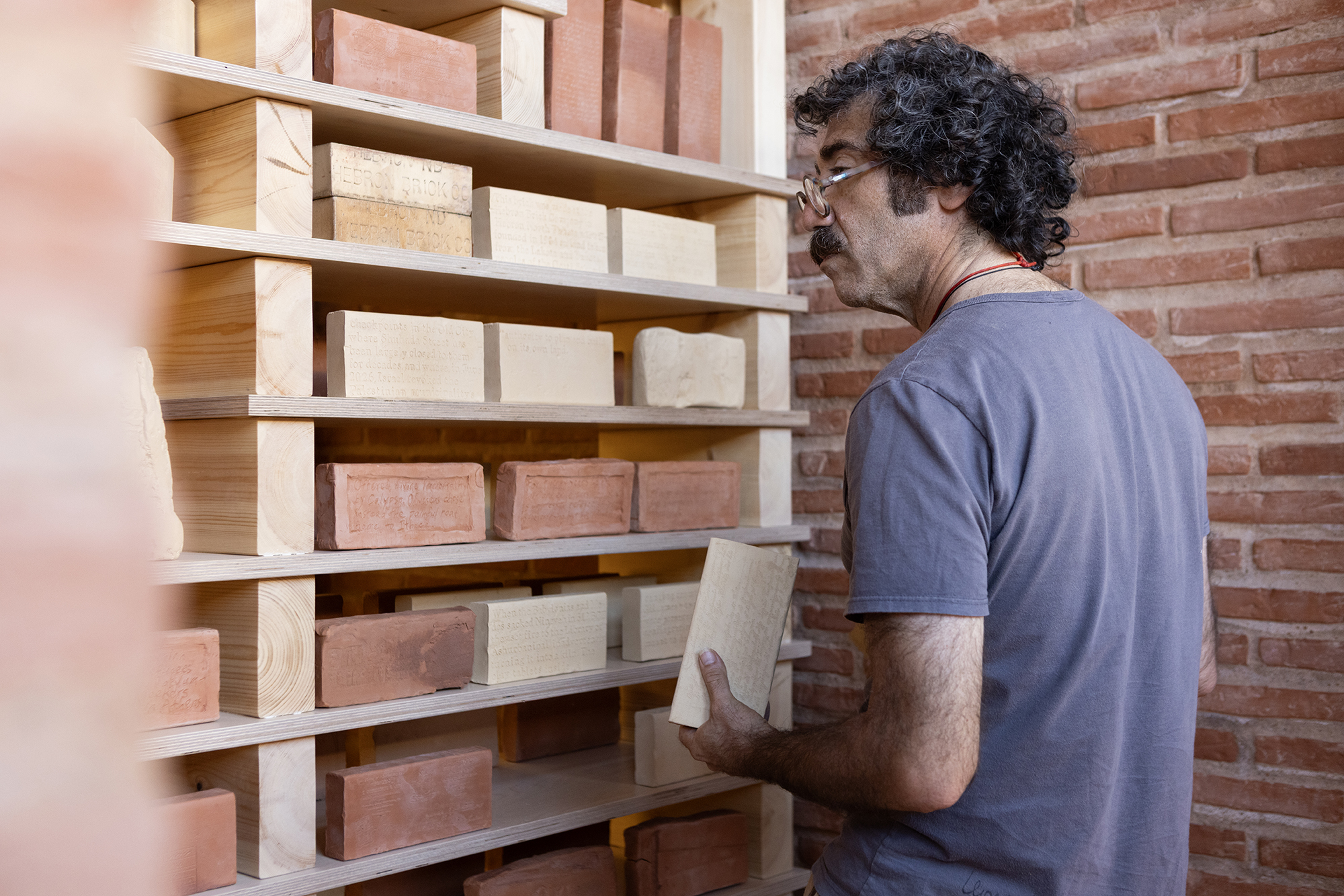
The first of these is an old pair of reading glasses that once belonged to an Iraqi-Jewish man from Baghdad. ‘These lenses of the past will help me to see more clearly now,’ he writes in the accompanying text before leading the viewer through an illustrated explanation of some of the ideas informing his artistic practice and What You Leave Behind Is Not What Is Engraved. Among the drawings are temporary migrant tents on the slopes of the Acropolis, the kiln and bricks in the exhibition, a pocket watch that needs daily winding to keep time (present and future), and a sketch of a prayer book. Through them, Rakowitz proposes that what endures is not simply what monuments preserve, but what people carry, remember, replace and weave into one another’s lives.
Not only a work of art, Shetakha for Athens is a witness to Rakowitz’s live performance: an imprint of shared experience. In the future it will also become an archival document for the first exhibition to take place at the reopened Old Acropolis Museum.